Guide
How do you get through a difficult book with AI, instead of just having it summarised?
Most AI reading tools arrive after the fact — a summary, a set of flashcards, a recap of a book you never got through. A difficult book fails at the paragraph you are on. Here is what an AI reading companion that explains as you read does differently, and where it stops.
A hard book does not defeat you at the end. It defeats you on page 40, in a paragraph that will not resolve — an argument with a step missing, a term used in a sense nobody defined, a sentence that is grammatical and still opaque. You read it three times, lose confidence, and the book quietly joins the pile.
Almost every AI reading tool addresses a different moment: after. Summarise this book. Turn this chapter into flashcards. Give me the key takeaways. All of that assumes you got through it. If you had, you would not have needed the tool.
Explaining as you read, not after
The useful intervention is small and immediate: at the sentence, while you still have the context of the last twenty pages in your head, in language pitched at where you actually are.
So the shape of the app matters. In Resage the book is the page — a full-width reader you turn like any e-reader, in the file's own layout. The AI is a bar at the bottom that does nothing until you call it. Select a sentence and ask about that sentence; the answer comes back about the passage in front of you, not about the book in general.
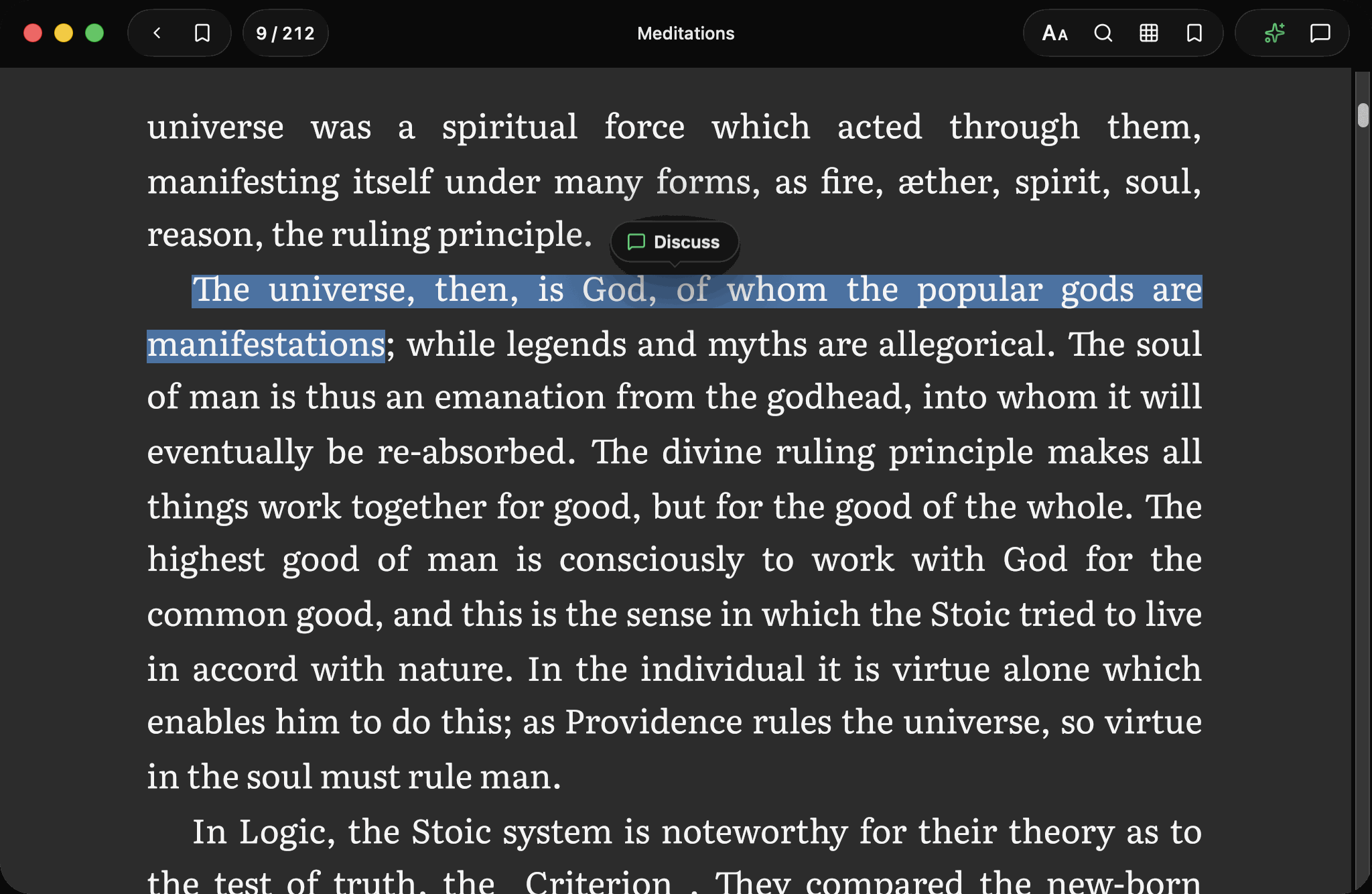
That is deliberately unglamorous. It is also the difference between finishing the chapter and not.
Asking a book questions is no longer the hard part
It is worth being honest about the category. Several tools now let you ask questions about a book — reading apps with a built-in assistant, subscription libraries with an "ask this book" button, browser tools you paste a file into. If your bar is "can I ask it something", that bar has been cleared by a dozen products.
Two things still decide whether any of it helps on a difficult book.
Whether the explanation is pitched at you. The same paragraph of Hegel needs one answer for someone who has read Kant and a completely different one for someone who has not. A tool with no idea which you are will average the two and be useless to both. Worse, it will do it again tomorrow, because it forgot you when you closed the tab.
Whether the answer is anchored. Models have read far more about famous difficult books than of them. Ask about a passage and you can easily get the received summary of the work instead of a reading of the sentence you are looking at — confident, fluent, and not about your text.
What "calibrated to you" actually means
Resage remembers your reading and your conversations, across files and chats. It is not a summary of your books.
- Where your understanding sits in a subject, as evidenced by what you have asked.
- What confused you before, and what unstuck it.
- Which kinds of explanation land for you — worked example, analogy, formal statement, historical framing.
- What you are reading for: the argument, the application, the pleasure of it.
It carries across books, which is where it compounds. The first book is a reader with AI in it. By the sixth, the explanations start at the right altitude without you setting the scene, and the idea you met three books ago under a different name gets pointed at when it reappears.
To do this, Resage keeps your discussions with the AI companion, including the passages they quote, in your account, together with short notes the AI maintains about you. You can turn memory off or clear all of it at any time in Settings under Memory.
Anchored to your text, and honest when it is not
On difficult books this matters more than anywhere else, because classics and primary sources are exactly where a model is most confident and least reliable.
Resage answers from the text in front of you. When it draws on general knowledge instead, it says so explicitly. Any claim that "the book says X" comes with the passage it came from, so you can look. And where it cannot find support, the answer is that it is unsure — which is less impressive and considerably more useful than a fluent invention.
With AI consent, cloud Digest prepares the whole book, including scanned pages, so you can discuss any part from anywhere in the book.
What this is not
- Not a summariser. It does not produce the book-in-ten-minutes artefact you read instead of the book. The point is to get you through the actual text.
- Not a flashcard generator. Recall tools work on material you already understood. This is for the part before that.
- Not a tutor. It reads level with you — no lesson plan, no quizzes, no progress score, no opinion about your discipline.
- Not a note-taking app. No highlight export, no Obsidian sync, no wiki.
- Not a library. No books are included. You bring files you already own.
- Not magic on day one. Day one is a calm reader with a grounded discussion layer, which is already worth having. The memory is a week-thirty argument, and we would rather say so than pretend.
Where your reading lives
On Mac, iPhone, and iPad, newly imported books are uploaded for cloud preparation after you agree to AI data processing. There is no separate cloud-processing switch or local Digest option. Temporary uploaded originals are deleted when processing finishes, or within seven days if it cannot complete. Without AI consent, you can read with lightweight local parsing and no cloud-preparation upload. Existing books are not reprocessed automatically. Relevant passages are sent to the AI provider when you ask a question. Models are never trained on your content.
Your reading memory is stored with your account so it can follow you to another device, and is kept until you clear it, delete the file it came from, or delete your account. You can switch it off or clear it at any time.
Where it stops
- macOS 14.0 or later on Apple Silicon. iPhone is next; there is no Windows, Android or web version.
- Discussion needs a connection. Reading downloaded books works offline. Cloud Digest and AI discussion require AI consent and an internet connection.
- You bring your own files. PDF (kept in its original layout), EPUB, Word, TXT, Markdown, and DRM-free Kindle files (MOBI, AZW3). DRM-protected Kindle purchases cannot be imported.
FAQ
Is this just another tool where you can ask questions about a book?
Asking questions about a book is now table stakes — several tools do it. The two things that decide whether it helps on a hard book are how the explanation is pitched, and whether it is anchored. Resage remembers what you have read and discussed across books and conversations, so the depth is calibrated to what you already understand, and it grounds answers in the passage in front of you rather than in what the model recalls about the book.
How is this different from a tool that summarises a book or makes flashcards?
Those work on a book you have already finished, and they compress it. The problem with a difficult book is usually earlier than that: a paragraph that will not resolve on page 40. Resage sits with you at that paragraph. It does not produce a summary you read instead of the book.
Will it just make things up about a book it half remembers?
That is the failure this is built against. Answers are grounded in the actual text in front of you; when Resage draws on general knowledge rather than your file, it says so explicitly, and any claim that the book says something comes with the passage it came from. Where it cannot find support, it says it is unsure rather than inventing. There is a longer treatment of this in reading philosophy with AI.
Does it work on my own files, or only on a catalogue?
Your own files. No books are included. PDF, EPUB, Word, TXT, Markdown, and DRM-free Kindle files (MOBI, AZW3). DRM-protected Kindle purchases cannot be imported.
Does it teach, or grade me?
Neither. It reads level with you. There is no lesson plan, no quiz, no progress score. What it remembers is what you read and discussed, not a judgement about you, and you can turn it off or clear it at any time.
What does it cost?
Free to start, with a monthly discussion allowance. Importing and reading are not charged. Cloud Digest has its own monthly allowance (3, 30 or 90 books on Free, Plus or Pro), and scanned-page text recognition is counted by page (1,500, 8,000 or 24,000 pages a month). Resage Plus is $9.99 a month or $99.99 a year; Resage Pro is $29.99 a month or $299.99 a year, with 3x the Plus allowances. See pricing.