Resage vs ChatGPT
ChatGPT is the everything assistant — and for most things, that's exactly what you want. Reading isn't most things. Here's what changes when the tool is built around the page you're on, instead of a chat box with a file attached.
Updated July 2026
Let's start with the obvious: ChatGPT is one of the most capable tools ever shipped, and if you only keep one AI subscription, it's a reasonable one to keep. You can attach a PDF and ask questions, and for a contract clause or a quick summary, that's enough.
The trouble starts when the file is something you actually want to read — a dense report, a textbook, a classic. Then the chat-with-attachment shape works against you. There's no page, no layout, no sense of where you are. The answers float free of the text, close enough to sound right and hard to check. And when you come back next week — new chat, blank slate — everything you built up is gone.
Resage is what you get when you design for the reading case from scratch, rather than bolting a file onto a chat.
The short version
A reading app vs a general assistant
| Resage | ChatGPT | |
|---|---|---|
| What it is | A reading app | A general assistant |
| A real reader — original layout, pages, bookmarks | Yes | No — chat with an attachment |
| Knows the page you're on | Yes — ask without describing it | No |
| Memory of your reading | A learner model that compounds across files | General memory; Projects are silos |
| Stays sharp over months | Structured memory, not one endless chat | Long chats degrade (widely reported) |
| Answers grounded in your file | Quotes and page links; flags uncertainty | Can drift from the text |
| Where your files live | Your Mac + your own iCloud | Uploaded to OpenAI's servers |
| Everything that isn't reading | Not the job | Exceptional |
The page is the context
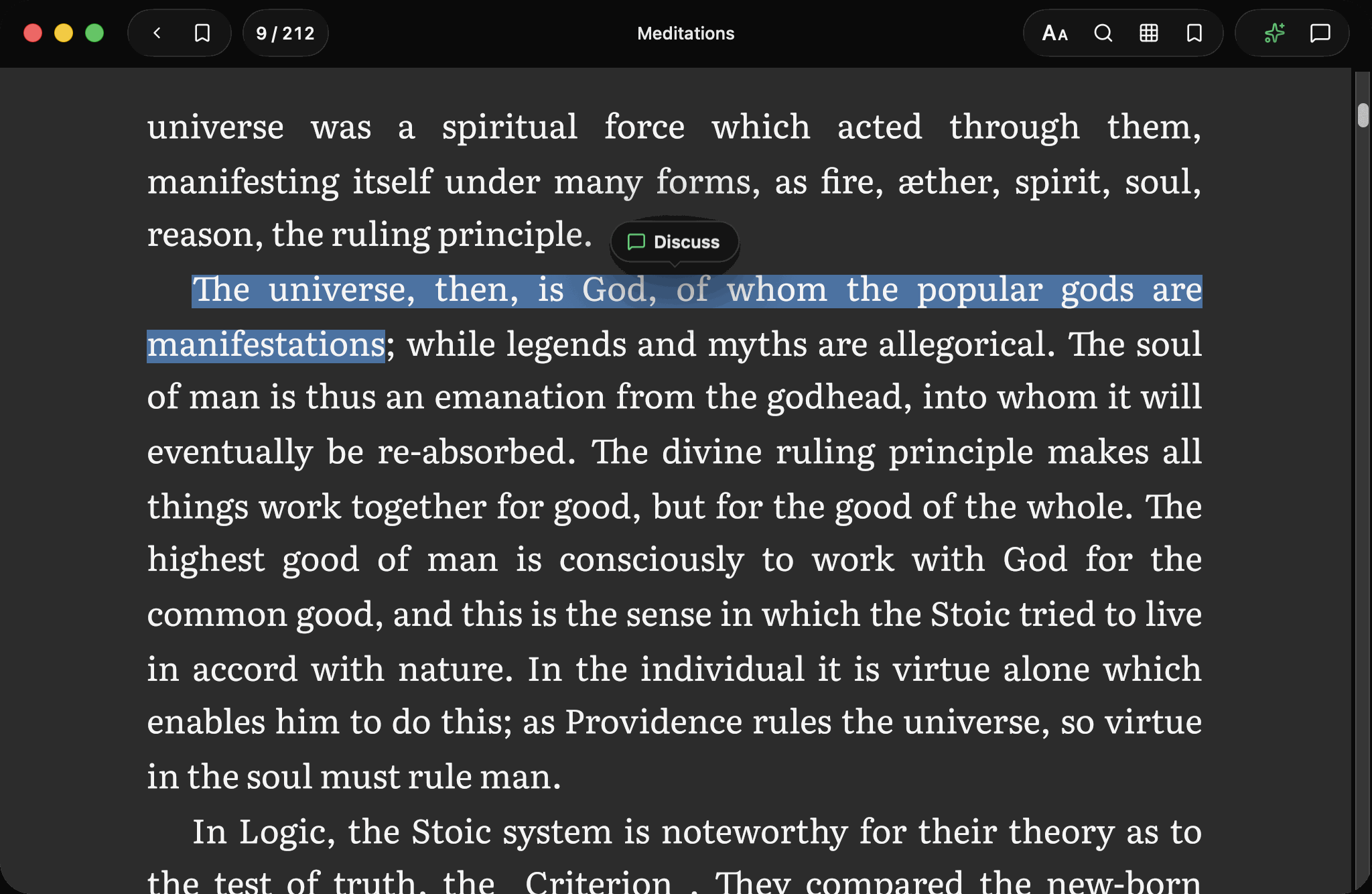
In ChatGPT, every question about a document starts with overhead: which file, which part, paste the passage or describe it. In Resage there's no overhead, because the reader and the AI share the same state. You're on page 214; it knows you're on page 214. Select a sentence and the passage goes across with your question. A faint ✦ at the end of a line opens a discussion about exactly that line — the page stays clean, the AI stays anchored.
Assistant memory is not a reading profile
ChatGPT's memory is real and getting better — it remembers facts about you, your preferences, context from past conversations. But it's a general memory, tuned for being a useful assistant. What you understood in chapter three, the concept you keep tripping on, whether examples or definitions work better on you — that's noise to a general assistant, so it doesn't keep it. And Projects, the closest thing to a reading workspace, deliberately silo their memory per project.
For Resage, that "noise" is the whole product. The learner model tracks exactly those things, across every file in your library, and every explanation you get is shaped by it. Thirty days in, the difference is not subtle. You can open the profile, read what it believes about you, and correct it — it's never a black box.
The conversation trap
With ChatGPT you face a bad choice on long material: start fresh chats and lose everything, or stay in one endless chat that degrades — users widely report answers getting slower and less reliable as a conversation grows. Neither is a way to read a 400-page file over three weeks.
Resage sidesteps the trap structurally: discussions are anchored to places in the text, and what matters is distilled into memory instead of being dragged along as an ever-longer transcript. Come back after a month and it's still sharp — and still remembers what you covered.
Grounded means checkable
A general model answers from everything it has ever read, which is precisely the danger with material it half-knows: summaries of the famous version rather than the edition in front of you. Resage answers from the text — it quotes, it links the page so you can jump and check, and when the text doesn't support an answer, it says so. If a claim is general knowledge rather than from your file, it's labeled as such.
Where ChatGPT wins
Almost everywhere else, honestly:
- Everything that isn't reading. Writing, coding, planning, images, voice, web search — Resage does none of it, on purpose.
- One assistant for your whole life. If you want a single subscription that does a bit of everything, that's ChatGPT, not a reading app.
- Quick one-off questions about short documents — where reading context and memory don't matter, the attachment flow is fine.
- Platforms. ChatGPT is everywhere; Resage is a Mac app first, with iPhone next.
Pricing
| Resage | ChatGPT | |
|---|---|---|
| Free tier | Yes — limited weekly discussion allowance | Yes — with usage limits |
| Paid | Plus: $4.99/mo, or $39.99/yr | Plus: $20/mo |
| Never metered | Importing, reading, read-through, text recognition | — |
ChatGPT prices as of July 2026, from public listings — check openai.com for current rates.
They're not competing for the same $20, though. Many Resage users keep a general assistant too — and stop feeding it their reading.
The verdict
Pick Resage if…
- You read long, serious files — and want to still be sharp on them weeks later
- You want answers anchored to the page, that you can check with one tap
- You want an AI that learns how you read, not just what you ask
- Your files shouldn't be uploaded wholesale to anyone's servers
Pick ChatGPT if…
- You need one assistant for everything — writing, coding, planning, search
- Your document questions are quick, one-off, and done
- You want the same tool on every platform you own
Common questions
Can't I just upload my PDF to ChatGPT?
You can, and for a quick question it works. What you don't get: the file as it was typeset, a page you're on, answers anchored to that page, or any memory of how you read that carries to the next file. Each upload starts the relationship over.
Doesn't ChatGPT have memory now?
It does — a general assistant memory. It isn't a reading profile: it doesn't track what you understood, where you got stuck, or which explanations landed, and Projects keep their memory siloed. Resage's learner model is built for exactly that.
Is Resage cheaper than ChatGPT Plus?
Resage Plus is $4.99/month or $39.99/year; ChatGPT Plus is $20/month as of July 2026. Different jobs, though — ChatGPT does far more than reading; Resage does reading better.
Also comparing: Resage vs NotebookLM Resage vs Apple Books Resage vs Readwise Reader
Start reading
Read anything. It learns you as you go.
Import your first file and see how it reads. Free to start.
Free to start — macOS 14.0+, Apple Silicon