Guide · Public Domain Classics
How do you read Marcus Aurelius's Meditations without getting lost?
Marcus Aurelius never wrote Meditations for you — it was a private notebook with no title, no chapters, and no intended reader. Here is why the book defeats so many readers on page 30, where to download clean public-domain editions, and how to read it with an AI companion that cites real passages without hallucinating.
Meditations is the quintessential book that almost everyone buys and almost no one finishes. People pick it up expecting a polished treatise on Stoic philosophy, get through thirty pages of seemingly disjointed aphorisms, and quietly put it down believing they failed the book.
You did not fail the book. The book was never written for readers.
Where to get clean, free editions
Because Marcus Aurelius lived in the second century AD, all original Greek manuscripts and historic English translations are completely in the public domain. You can download them legally in seconds without creating an account:
- Standard Ebooks — Meditations (George Long Translation): Meticulously typeset, clean EPUB markup, modern typography, and complete public-domain freedom. This is the version we recommend for reading on Mac.
- Project Gutenberg — Meditations #2680: Available as standard EPUB, Kindle MOBI, plain text, and HTML.
For more sources of open-access literature, browse our complete directory of free, legal ebook sources.
Why Meditations defeats so many readers
Understanding why Meditations feels frustrating is the key to unlocking it. The difficulty is not vocabulary or obscure terminology — it is structure:
1. It was never intended to be published. Marcus Aurelius called his notes Ta Eis Heauton ("To Himself"). Written largely while on military campaign along the northern frontier during the Marcomannic Wars, these were daily self-examinations. There is no introductory thesis, no linear progression of arguments, and no consideration for an outside audience.
2. Book 1 is an entire chapter of personal thank-yous. The entire first book consists of acknowledgments: thanking his grandfather for good morals, his mother for piety, and his tutor Rusticus for introducing him to the discourses of Epictetus. Readers looking for Stoic doctrine get bewildered immediately because no author writes an opening chapter for an audience this way.
3. The repetition is a training drill, not poor editing. One of the most common complaints is that Marcus says the same thing over and over. Across Book 2, Book 3, Book 8, and Book 10, he repeatedly reminds himself not to care about what other people think, not to get angry at deceitful courtiers, and to accept mortality. He repeated these notes because he was constantly wrestling with those exact feelings. The repetition is evidence of human struggle, not bad writing.
4. Stoicism is not emotional suppression. Translation artifacts often portray Marcus as cold and unfeeling. In reality, he wrote to prevent snap judgments from hijacking his peace of mind while dealing with the devastating Antonine Plague, betrayal by trusted generals, and the burden of imperial rule.
Reading Meditations with an AI companion
When you open the Standard Ebooks EPUB in a reader like Apple Books or Calibre, you can read the text smoothly. But when you hit a cryptic aphorism or want to trace how a concept evolves across all 12 books, standard reading apps leave you stranded.
In Resage, the AI companion lives directly inside the reading window on your Mac:
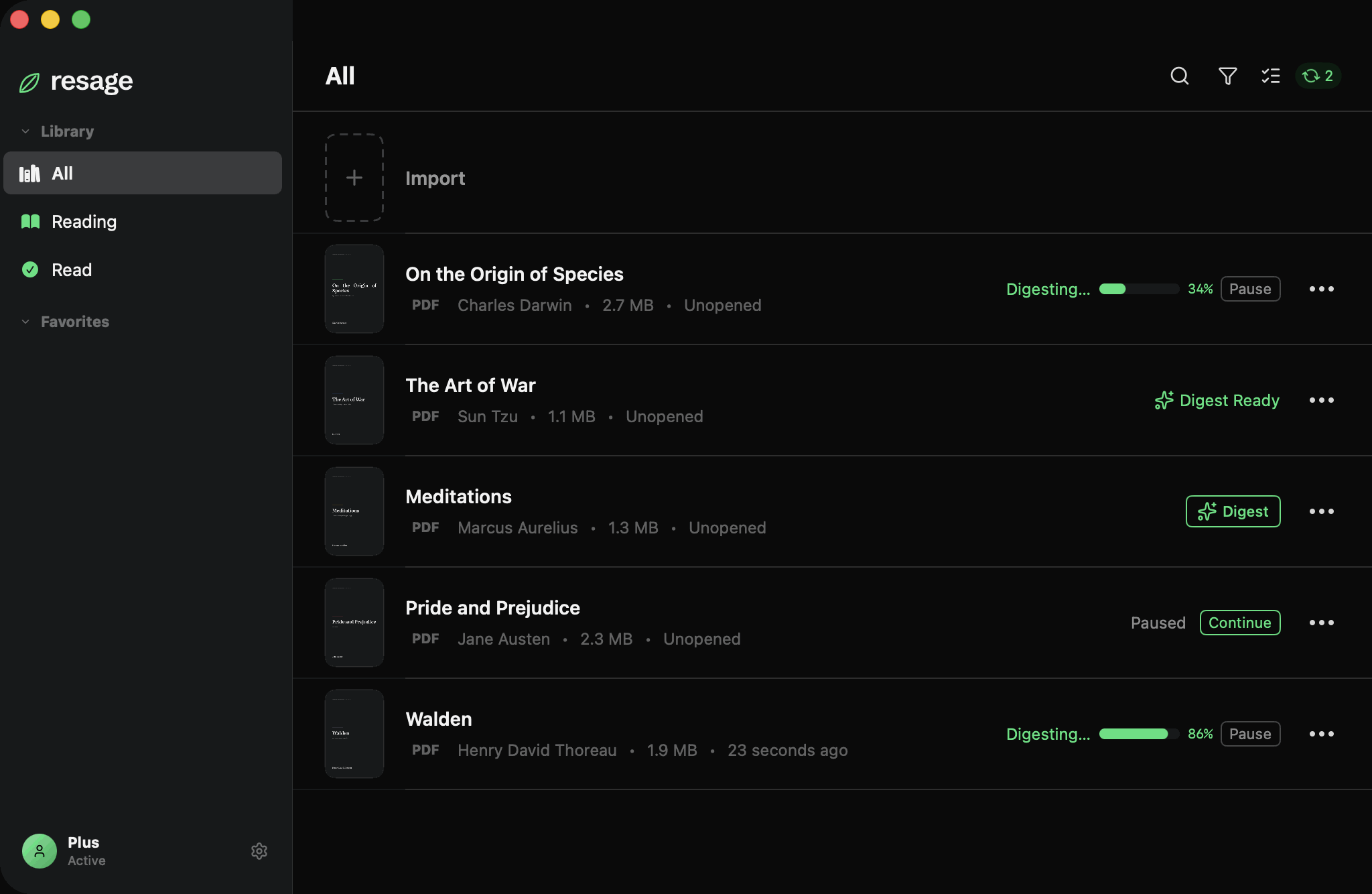
- Ask about the exact sentence in front of you: Highlight any passage — such as his reflection on morning inertia in Book 5, §1 — and ask why he frames getting out of bed as human duty. The passage travels with your question, ensuring the answer analyzes the actual Greek-to-English translation in front of you.
- Gather scattered themes across all 12 books: Instead of flipping back and forth, ask: "Find every place where Marcus tells himself to ignore other people's opinions, and arrange them in order." Resage uses full-text book search to pull citations from Book 2, 3, 4, and 8.
The anti-hallucination discipline: text vs. general knowledge
Classical philosophy is where generic AI models fail most frequently. Large language models have ingested millions of secondary blog posts, summaries, and forum arguments about Stoicism. When asked a specific question, a generic chat bot will confidently synthesize a plausible-sounding answer from general memory — even if the text you are reading says something entirely different.
Resage follows a strict tripartite grounding principle (detailed in our guide on reading philosophy with AI):
- Reach for the open text first: Every substantive assertion about what the book claims is backed by a direct, clickable citation link to the exact paragraph in your file.
- Explicitly label external knowledge: When you ask a historical or comparative question whose answer does not exist in the primary source text, Resage explicitly labels the information as external:
General knowledge, not from text / 通用记载,非原文: The formal "dichotomy of control" is formulated by Epictetus in chapter 1 of the Enchiridion. While Marcus Aurelius applies this principle throughout Meditations (e.g. Book 4, §3), the clean pedagogical rule does not appear in this wording in your text.
- Refuse to fabricate: If a question asks whether Marcus Aurelius mentions a specific person or event not recorded in the book, Resage states that it cannot find support in the text rather than inventing a plausible narrative.
Connecting your reading across your library
As you read through Meditations, Resage builds private reading memory stored with your account. It tracks which concepts were intuitive, where you asked for clarification on historical context, and which explanations resonated:
When you later read Epictetus's Discourses, Seneca's Letters from a Stoic, or modern philosophical commentary, Resage remembers your familiarity with ancient Roman Stoicism and adjusts its explanations accordingly.
Where it stops
- macOS 14.0+ on Apple Silicon: Resage runs on modern Macs (M1/M2/M3/M4). iPhone is next; there is no Windows or web version.
- No bundled books: Resage does not bundle or sell books. You download the free DRM-free EPUB directly from Standard Ebooks or Gutenberg and open it in the app.
- It is an AI companion, not an infallible scholar: It reads alongside you to explain structure, contextualize historical references, and find passages. On critical interpretations, always tap the citation and verify against the primary text.
FAQ
Why does Meditations feel so repetitive?
Marcus Aurelius wrote Meditations as a personal spiritual notebook, not a published book. He repeatedly told himself to ignore public praise and accept mortality because he struggled with those exact impulses daily.
Where can I download a clean, free EPUB of Meditations?
Standard Ebooks provides a beautifully formatted, typography-compliant EPUB of George Long's translation. Project Gutenberg also offers multiple free public-domain formats including EPUB, Kindle MOBI, and plain text.
How does an AI reading companion handle translation differences in philosophy?
Resage answers questions directly from the specific file you have opened on your Mac. It quotes your open edition's vocabulary rather than hallucinating text from a different translation stored in a general training dataset.
What is the difference between text citations and general background in Resage?
When Resage cites what the author says, it attaches a verifiable link to the paragraph in your file. When providing external historical or philosophical context, it explicitly labels it as general knowledge rather than claiming it appears in the book.
What does Resage cost?
Free to start, with a monthly discussion allowance. Importing, reading and offline search are not charged; cloud text recognition is counted by page (1,500 pages a month on Free, 8,000 on Plus, 24,000 on Pro). Resage Plus is $9.99/month or $99.99/year for higher discussion volume; Resage Pro is $29.99/month or $299.99/year with 3x the Plus allowances.