Resage vs NotebookLM
NotebookLM — in the middle of becoming Gemini Notebook — is Google's research notebook: upload sources, get cited answers, generate audio overviews. Resage is a reading app: you read the actual pages of your own files, on your own Mac, with an AI that learns how you read. Here's the honest breakdown.
Updated July 2026
If you've used NotebookLM, you know what makes it good: drop a pile of sources into a notebook and ask questions across all of them, with inline citations that point back to the exact passage. It's free to start, it's backed by Google's models, and features like Audio Overviews turned it into one of the most talked-about AI products of the past two years.
But notice what's missing from that description: reading. NotebookLM never shows you your file as it was typeset. Sources go into a panel; what you interact with is the chat and the notes — the document itself becomes fuel for answers. That's exactly right for research synthesis. It's the wrong shape for actually reading something from front to back.
Resage starts from the opposite end. It's a real reader — original layout, pages you turn, bookmarks, your highlights — with the AI in a quiet bar at the bottom. The question isn't "which tool is smarter." It's what you're doing with the file: mining it, or reading it.
The short version
A reader vs a research notebook
| Resage | NotebookLM | |
|---|---|---|
| What it is | A reading app | A research notebook |
| Read your file as it was typeset — pages, layout, bookmarks | Yes | No — a sources panel |
| Answers cite the text | Yes — tap to jump to the page | Yes — inline citations |
| Learns how you read, across files | Yes — one compounding learner model | No — each notebook is a silo |
| Where your files live | Your Mac + your own iCloud | Uploaded to Google's servers |
| Scanned files | Recognized automatically, on-device | Processed in the cloud |
| Audio & video overviews | No | Yes — a genuine strength |
| Native Mac app | Yes | No — web and mobile |
Reading is not sourcing
NotebookLM's three-panel layout — sources, chat, studio — tells you what it thinks a document is for: answering questions and generating artifacts. That's a fine theory for a stack of meeting notes or twenty papers you'll never read in full.
It breaks down the moment a file deserves to be read in order. There's no page you're on, no sense of place, no "I'm halfway through and it's building an argument." In Resage the file is the interface: you turn full pages exactly as they were laid out, and when something stops you, you ask about it right there — the AI already knows the page in front of you, so you never paste passages or describe what you're looking at.
One learner model vs many silos
This is the structural difference that compounds. In NotebookLM, every notebook starts from zero. The tool never carries anything about you from one notebook to the next — and there's no profile of you it could carry.
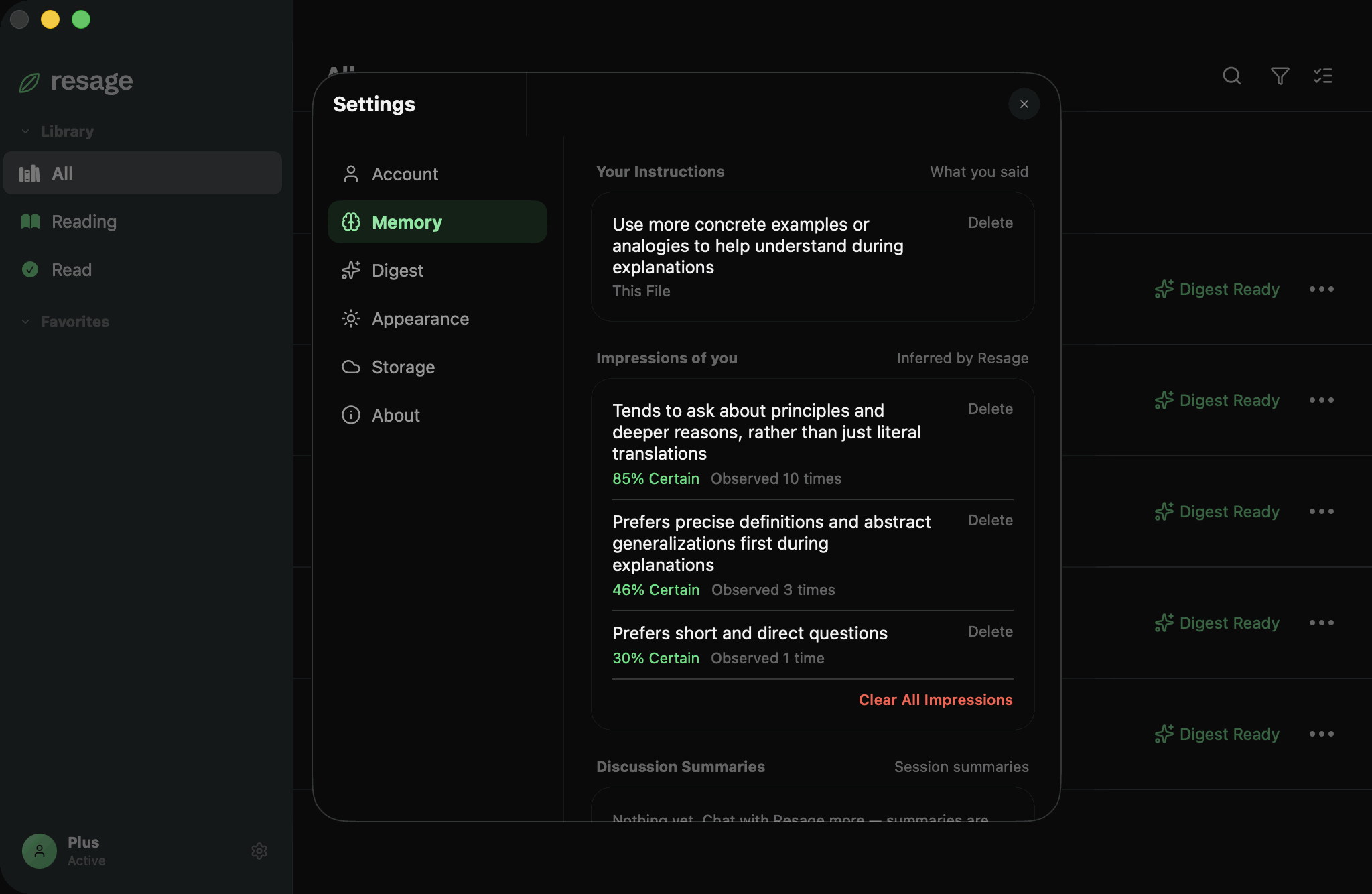
Resage keeps a private learner model: what you understand, where you got stuck, which explanations actually landed. It's one model across everything you read, so a file you open in month three gets explained better than the one you opened on day one. Everything it infers lives on a page you can read and correct — facts it's sure of stay, guesses fade if they aren't borne out.
Your files, your hardware
NotebookLM stores your sources on Google's servers until you delete them. Google says it doesn't train models on notebook content, and for many files that trade is fine.
Resage is built the other way: files are parsed, indexed and OCR'd on your Mac, and sync through your own iCloud — nothing passes through our servers. When you ask a question, only the few passages needed to answer are sent, and used only to answer. If your library includes work documents, drafts, or anything you'd rather not upload wholesale, that's not a feature difference — it's an architecture difference.
Grounded, both of them — differently
Credit where due: NotebookLM's citations are real and good. Resage grounds answers the same way — in the actual text, with page links that jump the reader straight to the source — and adds one habit that matters on serious material: when it isn't sure, it says so instead of producing something plausible. With classics and primary sources, an honest "the text doesn't say" beats a confident invention.
Where NotebookLM wins
Resage is a reading app, deliberately. If your work looks like the following, NotebookLM is the better tool — and genuinely excellent at it:
- Multi-source synthesis. Dozens of sources in one notebook, queried as a set — literature reviews, briefing prep, research reports. Resage discusses the files in your library, but it isn't built around cross-source report generation.
- Audio and video overviews. Turning documents into podcast-style audio (in 80+ languages) or narrated video explainers is NotebookLM territory. Resage has nothing like it — and doesn't plan to.
- Free, at Google scale. A generous free tier, with higher limits bundled into Google's AI subscriptions.
- Sharing and teams. Notebooks can be shared; a Resage library is personal by design.
The verdict
Pick Resage if…
- You actually read your files — in order, in their original layout
- You want the AI to learn how you read, and get better month over month
- Your files shouldn't leave your machine
- You want a native Mac app, not a browser tab
- Scanned files should just work, without OCR tools
Pick NotebookLM if…
- You're synthesizing across many sources at once
- Audio Overviews are the point for you
- You want to share notebooks with a team
- You live in Google's ecosystem and its AI plans
Plenty of people will use both: NotebookLM to mine a pile of sources, Resage to actually read the ones that matter. They overlap less than "AI + documents" makes them sound.
Common questions
Is Resage a NotebookLM alternative?
For reading your own files, yes. For multi-source research reports and audio overviews, no — NotebookLM remains the better tool for that, and this page says so above.
Does NotebookLM learn how I read?
No. Each notebook is an isolated container, and there is no cross-notebook profile of you. Resage keeps one private learner model that compounds across your files — and you can read and correct it.
Do my files get uploaded?
In NotebookLM, yes — sources live on Google's servers until you delete them. In Resage, files stay on your Mac and your own iCloud; only the few passages needed to answer a question are ever sent.
NotebookLM is now Gemini Notebook — does this comparison still apply?
Yes. Google renamed NotebookLM to Gemini Notebook in July 2026 and folded it into the Gemini brand. It's the same product and the same shape: a cloud research notebook you upload sources into. Everything on this page holds under either name, so if you're looking for a Gemini Notebook alternative for reading your own files, this is the comparison you want.
Also comparing: Resage vs ChatGPT Resage vs Apple Books Resage vs Readwise Reader
Start reading
Read anything. It learns you as you go.
Import your first file and see how it reads. Free to start.
Free to start — macOS 14.0+, Apple Silicon