Guide
Is there an AI that remembers what you have read, across books and not just one chat?
Every session with a general assistant starts at zero — you re-explain your background, and it re-explains what you already understood. Here is what a reader that remembers you across books and conversations actually changes, and what it is not.
The most tiring thing about reading with an AI assistant is not the answers. It is the throat-clearing before them — establishing, again, what you already know, what you are reading for, and which explanations do not work on you. Tomorrow you will do it again.
Meanwhile the thing worth keeping is not the text you highlighted. It is the shape of your own understanding: what you grasped immediately, what you had to have explained three times, which analogy finally made it click. No app keeps that, so it evaporates.
People try to solve it with note systems, and mostly it does not take:
"Help, I'm stuck in note-taking hell. How do I get out?" — r/ObsidianMD
"Ask HN: How do you remember the best stuff from non-fiction books?" — Ask HN
A folder of clippings is not the answer, because the clippings were never the problem. Re-explaining yourself is.
What Resage remembers
Not a summary of your books. A running memory of your reading and your conversations, kept across files and across chats:
- What you have been reading, and what you asked about it.
- Where you got stuck before, and what unstuck it.
- Which kinds of explanation land for you — worked example, analogy, formal statement, historical framing.
- What you tend to read for: argument structure, application, pleasure.
It applies across books — which is where the compounding is. Book one is a reading app with AI in it. Book six is a reading app that already knows you skip the derivations and want the counterexample.
To do this, Resage keeps your discussions with the AI companion, including the passages they quote, in your account, together with short notes the AI maintains about you. That is stored on our servers so it follows you to your next device. We say so plainly because it is a real trade-off: memory that works needs the conversations behind it.
You stay in control
In Settings → Memory there are two controls:
Remember My Reading. Turn it off and nothing new is remembered. What was kept before stays until you clear it.
Clear All Memory. One tap deletes everything Resage keeps about you on the server — conversations, quoted passages, notes — and it starts from zero. It cannot be undone.
Deleting a file can also remove the conversations about it, and deleting your account removes all of it.
What it changes in practice
Explanations start at the right altitude. No re-establishing your background, because it is already known.
Connections across books appear. The idea you met three books ago, under a different name, gets pointed at when it reappears.
Repeats are shorter. The second time you meet the same sticking point, it is treated as a return rather than a first encounter — including what worked last time.
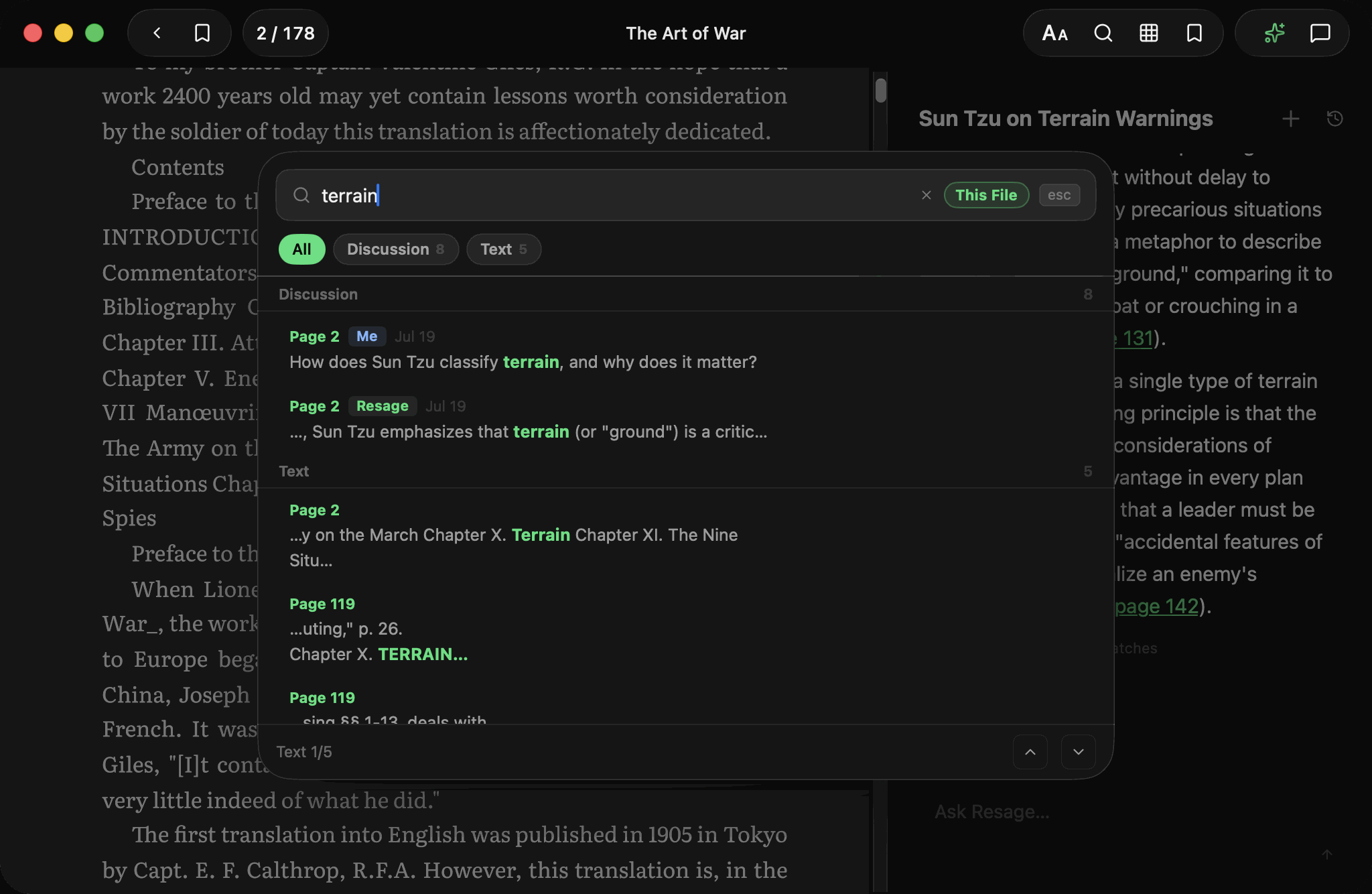
Your own history is searchable. Search covers the text of a book and your past discussions in one query. Six weeks later, what you usually want back is the explanation, not the sentence.
What it is not
- Not a note-taking app. No highlight export, no Obsidian sync, no wiki. If you want a second brain full of clippings, this is not it.
- Not a copy of your library. Memory is built from your conversations and the passages they quote, not from whole books.
- Not training data. Your content is never used to train models. Your memory stays with your account, and you can turn it off or clear it at any time.
- Not a tutor. It reads level with you. It has no lesson plan and no opinion about your discipline.
- Not magic on day one. Day one is a reader with a grounded discussion layer, which is already useful. The compounding is a week-thirty argument, and we would rather say that than pretend otherwise.
Where your reading lives
On Mac, iPhone, and iPad, newly imported books are uploaded for cloud preparation after you agree to AI data processing. There is no separate cloud-processing switch or local Digest option. Temporary uploaded originals are deleted when processing finishes, or within seven days if it cannot complete. Without AI consent, you can read with lightweight local parsing and no cloud-preparation upload. Existing books are not reprocessed automatically. For an AI answer, only the relevant passages, your question, and relevant reading memory are sent to the AI provider. Your content is never used for model training.
Your reading memory is stored with your account so it can follow you to the next device, and it is kept until you clear it, delete the file it came from, or delete your account.
Where it stops
- macOS 14.0 or later on Apple Silicon. iPhone is next; no Windows, Android or web version.
- Discussion needs a connection. Reading downloaded books works offline. Cloud Digest and AI discussion require AI consent and an internet connection.
- You bring your own files. No books are included. PDF, EPUB, Word, TXT, Markdown, and DRM-free Kindle files (MOBI, AZW3).
FAQ
How is this different from ChatGPT's memory?
Two things. What is kept here is specific to reading — your conversations about books, your sticking points, which explanations work — rather than general facts about you. And it is anchored to books you actually read, so it is evidenced rather than asserted. A longer comparison: Resage vs ChatGPT.
Can I see or delete what it remembers?
You can turn memory off or clear all of it at any time in Settings under Memory. Deleting a file removes the conversations about it, and deleting your account removes everything. Resage does not currently show you the remembered content itself.
Does the memory work across different books?
Yes, that is the point of it. What it remembers about how you read carries from one book to the next.
Is my reading used to train models?
No. Your content is never used for training. With your AI data-processing consent, newly imported books are prepared in the cloud on Mac, iPhone, and iPad; temporary uploaded originals are deleted when processing finishes. Without consent, reading uses lightweight local parsing without cloud-preparation uploads.
What does it cost?
Free to start, with a monthly discussion allowance. Importing and reading are not charged. Cloud Digest has its own monthly allowance (3, 30 or 90 books on Free, Plus or Pro), and scanned-page text recognition is counted by page (1,500, 8,000 or 24,000 pages a month). Resage Plus is $9.99 a month or $99.99 a year; Resage Pro is $29.99 a month or $299.99 a year, with 3x the Plus allowances.