Guide
Why don't book summaries and flashcards help you actually understand a book?
Summaries and flashcards are good at something real — holding on to material you already understood. Neither one gets you past the paragraph that stopped you. Here is what the research on flashcards actually found, and what it suggests instead.
Open any AI reading tool and you will be offered one of two things: a summary of the book, or a deck of cards made from it. Both are downstream products. Both assume the reading already happened.
That is the mismatch. The reason a difficult book defeats you is almost never that you finished it and forgot it. It is that on page 40 there is an argument with a step missing, or a term used in a sense nobody defined, and after the third pass you quietly put the book down. Nothing that compresses a book you did not get through can help with that.
Flashcards are a retention tool, and they are good at it
It is worth conceding this properly, because the internet is full of people overstating it in both directions.
Retrieval practice — trying to produce an answer from memory before checking it — is one of the best-evidenced study techniques in the literature, and flashcards are a cheap, convenient way to do it. When it has been tested head to head against passive review, the active method tends to win.
The frontier of flashcard research reflects what the tool is for. A 2024 paper on content-aware scheduling, KARL, builds a model that reads the text of your cards to predict whether you will recall the answer, so cards can be scheduled at better moments. That is a sophisticated system, and the thing it optimises is recall. Not comprehension. Recall.
What happens when students actually use them
The classroom record for ordinary flashcard use is mixed rather than glowing:
- In one introductory psychology class, students who used flashcards scored higher on the first exam — but the benefit was gone by the second, and only marginal on the third (Golding, Wasarhaley & Fletcher, 2012).
- Self-reported use of student-made flashcards has been found unrelated to GPA (Hartwig & Dunlosky, 2012).
- In a survey of how students use them, 82.9% said they used flashcards to remember vocabulary, and no student reported using them to develop deeper understanding or application of a concept (Wissman, Rawson & Pyc, 2012).
- Roughly 70% of students self-test in order to check how well they have learned something; only about 18% do it in order to learn more (Karpicke, Butler & Roediger, 2009).
None of that says flashcards are useless. It says people reach for them at the definition level, and the definition level is not where a hard book breaks.
The part that worked was the explaining
The most interesting result here is not an argument against flashcards. It is an argument about which step in the process is doing the work.
Senzaki, Hackathorn, Appleby and Gurung (2017) tested a variant called Flashcards-Plus across three studies (n = 73, 62 and 434). Students started with an ordinary card — term on one side, textbook definition on the other — and then did two more things: restated the definition in their own words, and invented a realistic example from their own life. Students taught this method scored significantly higher on their exams than those who were not.
Read that again from the other direction. The card was constant. What was added was being made to re-express an idea in your own language and connect it to something you already have. That is not a property of flashcards. That is what a conversation about a text does.
And it is precisely the step that an AI flashcard generator removes on your behalf. It writes the card, writes the paraphrase, sometimes writes the example too. The deck looks like the one that worked in the study, and the part that produced the gain has been done by someone else.
What a book actually needs in the moment
The intervention that matters on a hard book is small, immediate, and pitched at you: at the sentence, while the last twenty pages are still in your head, in language that assumes what you already know and no more.
That is the whole shape of Resage. The book is the page — a full-width reader you turn like any e-reader, in the file's own layout. The AI is a bar at the bottom that does nothing until you call it. You select the sentence that stopped you and ask about that sentence, and the answer comes back about the passage in front of you rather than about the book in general.
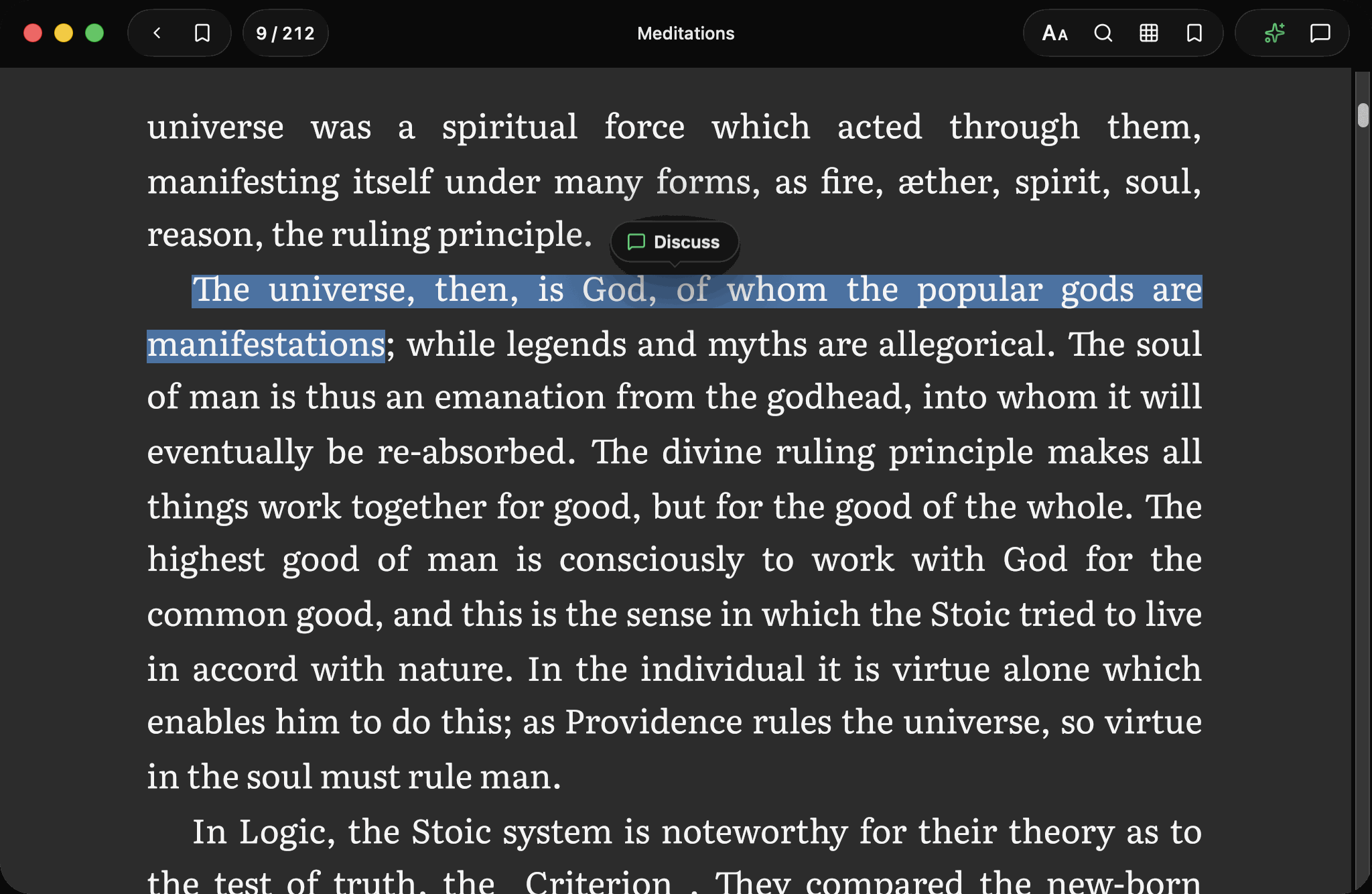
Two things decide whether that is worth anything.
Whether the explanation is pitched at you. The same paragraph needs one answer for a reader who has the background and a different one for a reader who does not. A tool with no idea which you are averages the two and helps neither. Resage remembers what you have read and discussed across books and conversations, so the depth of an explanation is calibrated to what you have already shown you understand. It carries across books, which is where it compounds.
Whether the answer is anchored. Models have read far more about famous difficult books than of them, so a question about a passage can easily return the received summary of the work instead of a reading of your sentence. Resage answers from the text in front of you; when it draws on general knowledge instead, it says so explicitly, and any claim that the book says something comes with the passage it came from.
And memory, then?
You do end up remembering more of a book you argued your way through than one you were handed the summary of — but that is a side effect, not the feature. Resage does not try to be your recall system. If you want spaced repetition, Anki is excellent and we are not competing with it.
What Resage keeps is the other thing: your conversations about the book, so it can remember you across files. That memory is stored in your account, and you can turn it off or clear it at any time in Settings.
What this is not
- Not a flashcard generator. No decks, no spaced repetition scheduler, no Anki export.
- Not a summariser. It does not produce the book-in-ten-minutes artefact you read instead of the book.
- Not a quiz engine. No tests, no scores, no streaks.
- Not a note-taking app. No highlight export, no Obsidian sync, no wiki.
- Not a tutor. It reads level with you — no lesson plan and no opinion about your discipline.
- Not a library. No books are included. You bring files you already own.
Where it stops
- macOS 14.0 or later on Apple Silicon. iPhone is next; there is no Windows, Android or web version.
- Discussion needs a connection. Reading downloaded books works offline. Cloud Digest and AI discussion require AI consent and an internet connection.
- You bring your own files. PDF (kept in its original layout), EPUB, Word, TXT, Markdown, and DRM-free Kindle files (MOBI, AZW3). DRM-protected Kindle purchases cannot be imported.
- On Mac, iPhone, and iPad, newly imported books are uploaded for cloud preparation after you agree to AI data processing. There is no separate cloud-processing switch or local Digest option. Temporary uploaded originals are deleted when processing finishes, or within seven days if it cannot complete. Without AI consent, you can read with lightweight local parsing and no cloud-preparation upload. Existing books are not reprocessed automatically. Relevant passages are sent for AI answers. Models are never trained on your content.
FAQ
Are flashcards bad?
No. Retrieval practice is one of the best-evidenced study techniques there is, and flashcards are a convenient way to do it. The claim here is narrower: what flashcards are good at is retention of material you have already understood. If the problem is that a paragraph will not resolve, a card cannot help — you cannot write a card for something you have not understood yet.
What did the research actually find?
Two things worth separating. Flashcards used the ordinary way have a mixed record: one classroom study found a benefit on the first exam that had faded by the second, and self-reported flashcard use has been found unrelated to GPA. But when students were taught to add two steps — restate the term in their own words, then invent an example from their own life — exam scores rose significantly across three studies. The gain came from the explaining, not from the card.
So does Resage generate better flashcards?
No. Resage does not generate flashcards, quizzes or summaries, and there is no export to a note app. It is a reader with a discussion layer: you read the actual book, and when a passage stops you, you ask about that passage and get an explanation pitched at what you already understand. There is a fuller account in getting through a difficult book with AI.
Isn't a summary useful for deciding what to read?
Yes, and that is a fair use of one. A summary is a good triage tool and a good reminder of a book you have read. It becomes a problem only when it stands in for reading a book you never got through — you end up with the vocabulary of the argument and none of the argument.
What does Resage cost?
Free to start, with a monthly discussion allowance. Importing and reading are not charged. Cloud Digest has its own monthly allowance (3, 30 or 90 books on Free, Plus or Pro), and scanned-page text recognition is counted by page (1,500, 8,000 or 24,000 pages a month). Resage Plus is $9.99 a month or $99.99 a year; Resage Pro is $29.99 a month or $299.99 a year, with 3x the Plus allowances. See pricing.
References
- Senzaki, S., Hackathorn, J., Appleby, D. C., & Gurung, R. A. R. (2017). Reinventing flashcards to increase student learning. Psychology Learning & Teaching, 16(3), 353–368. doi:10.1177/1475725717719771. The Golding et al. (2012), Hartwig & Dunlosky (2012), Wissman et al. (2012) and Karpicke et al. (2009) findings quoted above are as reported and cited in this paper.
- Shu, M., Balepur, N., Feng, S., & Boyd-Graber, J. (2024). KARL: Knowledge-Aware Retrieval and Representations aid Retention and Learning in Students. arXiv:2402.12291.