Resage vs Readwise Reader
Reader is the best tool ever built for one problem: the internet produces more worth reading than you can keep up with. Resage is built for a different one: the files that deserve your full attention, read deeply, with an AI that learns how you read. Here's where each belongs.
Updated July 2026
Readwise Reader earned its reputation. Save anything — articles, newsletters, RSS, PDFs, EPUBs, YouTube transcripts, tweet threads — triage it in one inbox, highlight ruthlessly, and let Readwise resurface what you highlighted so it isn't forgotten. If your reading problem is volume, Reader is the answer, and this page won't pretend otherwise.
But volume tools make trade-offs. Everything is reflowed into Reader's own format and stored in Reader's cloud. The AI, Ghostreader, answers questions about the document in front of you — and keeps nothing about you. It's a workflow for processing a stream, not for sitting with one difficult file for three weeks.
That second kind of reading is all Resage does.
The short version
Depth vs throughput
| Resage | Readwise Reader | |
|---|---|---|
| What it is | A deep-reading app for your files | A read-it-later app for everything |
| Capture the web — articles, newsletters, RSS, YouTube | No | Yes — the best there is |
| Original layout — pages as they were typeset | Yes | Reflow-first |
| AI while you read | Grounded discussion + a learner model | Ghostreader — per-document Q&A |
| Learns how you read, across files | Yes | No |
| Remembers your discussions | Yes — searchable, next to the text | Highlights and notes |
| Where your files live | Your Mac + your own iCloud | Reader's cloud |
| Scanned files | Recognized automatically, on-device | No |
| Platforms | Mac first, iPhone next | Web, Mac, Windows, iOS, Android |
Two different reading problems
Reader's whole design flows from triage: an inbox, feeds, progress bars, keyboard-driven archiving. It's honest, effective productivity software — for the stream.
Resage's design flows from attention: a full page, quiet margins, and one AI layer that stays out of the way until you ask. No inbox, no feeds, no queue guilt. You open the file you're working through and continue. The two apps don't disagree about reading — they're aimed at different halves of it.
Stateless Q&A vs a learner model
Ghostreader is genuinely useful: summarize, define, ask about the document. But every answer starts from zero knowledge of you — it can't, by design, know that you've already worked through this concept in another file, or that abstract definitions never land for you.
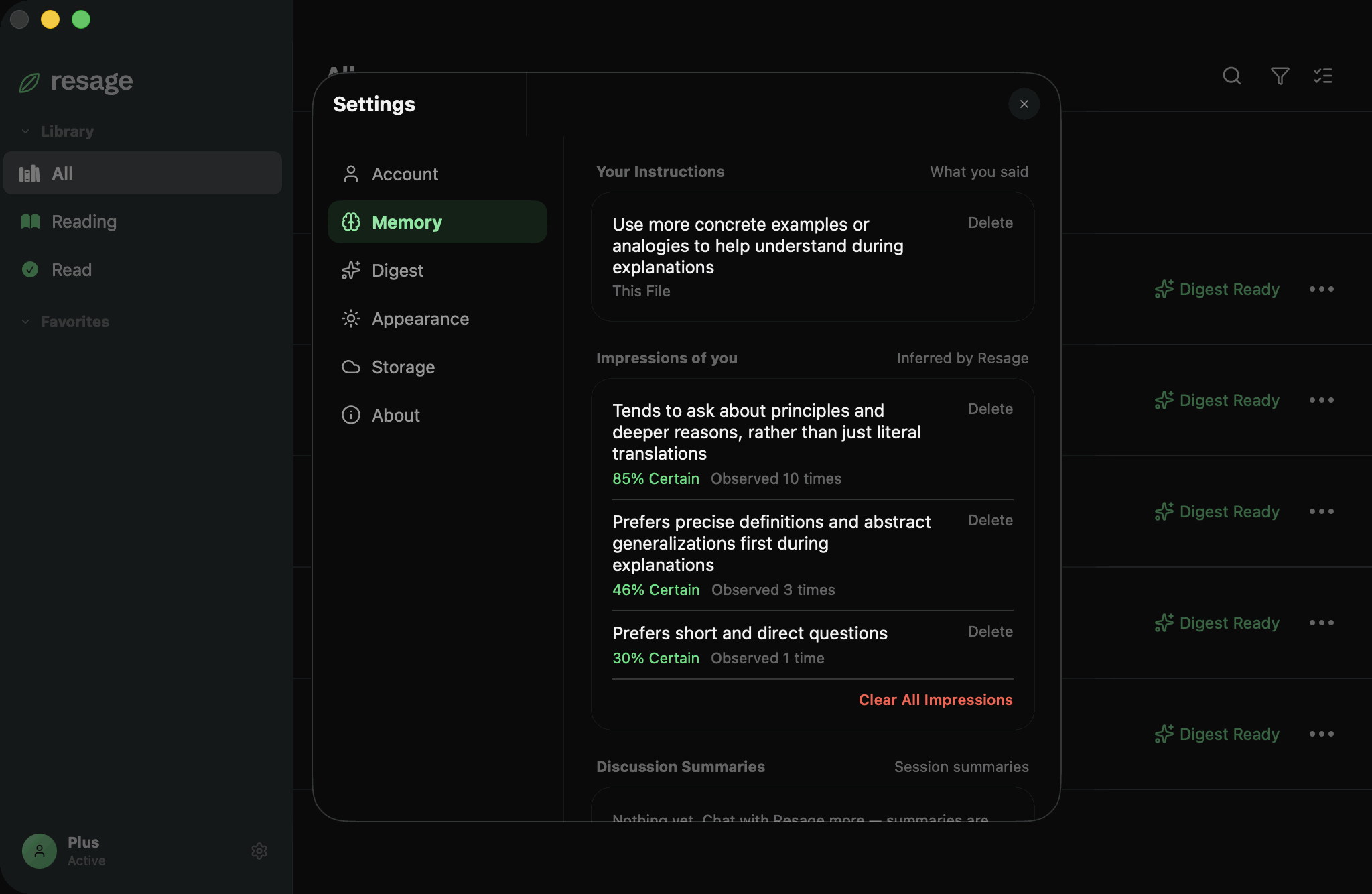
Resage's answers come through a private learner model — what you understand, where you got stuck, which explanations actually worked — built up across every file and every discussion, and editable by you. The tenth file you read with Resage is explained noticeably better than the first. That compounding is the product.
Your files, not another cloud
Reader is a cloud service: your documents are uploaded, reflowed, and stored on Readwise's servers — that's what makes the everywhere-sync work. Resage keeps files on your Mac and in your own iCloud; parsing, indexing and OCR happen on-device, and only the few passages needed to answer a question are ever sent. For personal archives, work documents, or anything you'd rather not hand to another subscription service, the architectures aren't comparable.
The page as it was made
Reflow is right for web articles — they have no canonical layout anyway. It's wrong for typeset files: textbooks, papers with figures, scanned material, anything where the layout carries meaning. Resage shows the original page, zoomable, and handles the scanned case automatically — Digest recognizes the text on your Mac, no OCR tools, so even a pile of scanned pages becomes discussable.
Where Readwise Reader wins
- Capturing the internet. Save-to-read-later from any browser, newsletters into one inbox, RSS, YouTube transcripts — Resage does none of this.
- Highlight resurfacing. The Readwise half — daily spaced-repetition review of your highlights — has no Resage equivalent.
- Integrations. Export to Obsidian, Notion, Roam and friends; a public API.
- Every platform today. Web, Mac, Windows, iOS, Android, plus e-ink devices. Resage is Mac-first, iPhone next.
Pricing
| Resage | Readwise Reader | |
|---|---|---|
| Free tier | Yes — reading free, limited weekly discussion allowance | 30-day trial, then paid |
| Paid | Plus: $4.99/mo, or $39.99/yr | $9.99/mo billed annually, $12.99 monthly |
| Includes | Importing, reading, read-through, recognition never metered | Reader + Readwise resurfacing |
Readwise prices as of July 2026, from readwise.io — check there for current rates and discounts.
The verdict
Pick Resage if…
- Your serious reading is files — PDFs, EPUBs, scans, documents
- You want an AI that learns how you read and compounds across files
- Original layout matters — textbooks, papers, typeset material
- Your files should stay on your device
Pick Readwise Reader if…
- Your reading is mostly the web — articles, newsletters, feeds
- Triage and throughput are the problem you're solving
- You want highlights resurfaced on a schedule, everywhere
- You need Windows or Android today
Some people will run both, and it's a sane split: Reader for the stream, Resage for the files that deserve to be read slowly — and for an AI that still knows you next month.
Common questions
Is Resage a Readwise Reader alternative?
For the files you already have, yes — and a more private one. For capturing the web, no: that's Reader's home turf, and Resage doesn't do web capture at all.
How is Resage's AI different from Ghostreader?
Ghostreader answers questions about the document in front of you — useful, but stateless. Resage grounds answers in the text the same way, and additionally keeps a private learner model that compounds across everything you read.
Which is cheaper?
Resage Plus is $4.99/month or $39.99/year; Reader is $9.99/month billed annually ($12.99 monthly) as of July 2026, which also includes Readwise's highlight resurfacing. Different jobs — see the verdict above.
Also comparing: Resage vs NotebookLM Resage vs ChatGPT Resage vs Apple Books
Start reading
Read anything. It learns you as you go.
Import your first file and see how it reads. Free to start.
Free to start — macOS 14.0+, Apple Silicon